The Challenge
Before the introduction of a centralized software system, the logistics provider relied heavily on manual processes. The operation lacked live shipment visibility, meaning customer service agents were blind to the exact location of packages once they left the origin hub.
Furthermore, the dispatch teams struggled with inefficient pickup route coordination. Drivers were often sent across Doha on overlapping routes, wasting fuel and time. These inefficiencies compounded into severe delays in dispatch updates, creating massive customer support backlogs as clients constantly called to check their delivery statuses.
The Solution
To resolve the operational bottlenecks, I was contracted to engineer a complete, bespoke Logistics ERP from the ground up. The system needed to replace manual spreadsheets with a unified, real-time database accessible across multiple regional branches.
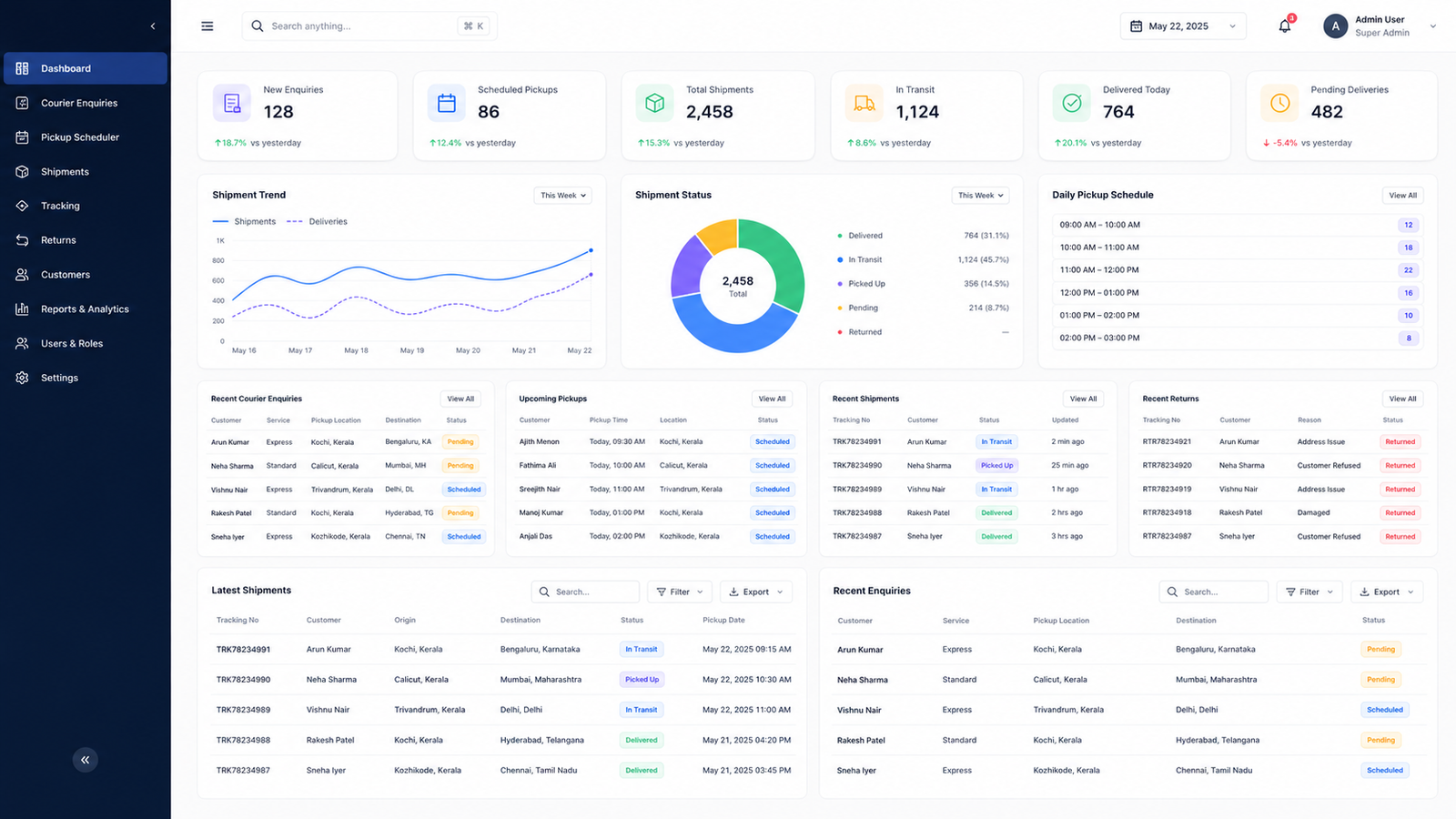
The core modules developed for this system included:
- Courier Enquiry Management: A module that captures and indexes incoming customer inquiries, allowing agents to instantly convert them into active bookings with minimal manual data entry.
- Live Shipment Tracking: A pipeline that generates unique, secure public tracking URLs. This allows customers to autonomously monitor status updates as their packages move through sorting hubs, custom checks, and final dispatch.
- Geographic Pickup Scheduler: A system that coordinates dispatch drivers by grouping courier pick-up requests geographically, ensuring optimal routes for regional drivers.
- Instant Price Estimators: A tool that calculates delivery costs instantly based on parcel weight, volume dimensions, destination zone, and selected shipping urgency.
- Multi-Branch Operations Dispatch: A robust module enabling dispatch centers in different regional Qatar hubs to transfer package custody securely, manage local inventory, and track incoming fleet vehicles.
How It Was Built
The architecture was designed using Laravel 8 as the primary MVC framework, leveraging its robust routing, database ORM (Eloquent), and queuing systems.
The frontend interface was built with Bootstrap 5 to ensure a clean, responsive layout accessible to dispatchers on both desktop monitors and tablets in the warehouse. The backend relied on a strictly relational MySQL database to maintain absolute data integrity across the shipment lifecycle. To handle real-time notifications, we integrated third-party SMS Gateway APIs, ensuring customers received instant alerts the moment their package status changed. The entire project was architected and delivered remotely from my office in Kerala, maintaining direct daily alignment with the Doha team.
The Outcome
The deployment of the custom Logistics ERP fundamentally transformed the client's operations. The most immediate impact was achieving 100% dispatch and route transparency. Customer service backlogs plummeted as clients utilized the public tracking URLs instead of calling the support desk.
Internally, the automated pickup route assignments drastically reduced driver downtime and eliminated geographic overlapping. The multi-branch architecture also provided the scalable foundation required to support their growing fleet operations across regional Qatar hubs.
Why This Matters for Your Business
Off-the-shelf logistics software often forces you to change your operations to match the software. Building a custom system ensures the software is molded entirely around your unique routes, hubs, and customer workflows.
Are you operating a logistics or courier business in Qatar? Learn more about my Courier Management Software Development Services or contact me to discuss your specific operational challenges.